Yes, it is Problem Season here in Crapland. Yesterday there was a new TNDOT, with a couple others still outstanding, and there are more problems, below. But I am less interested in solutions to the problems below than I am in how one might teach them, if that is even the proper phrasing. How, generally, does one teach the techniques, or perhaps the art, of problem-solving?
Some background on this post and its motivation. Firstly, what was not motivation was a comment by Anthony Harradine on a recent post, suggesting we have posts on “How does one teach X?”, for various values of X. I think this is an excellent suggestion and I plan to launch a new series of posts, so we can regularly discuss the teaching of X. But I do not regard problem-solving as an X, and it seems that teaching problem-solving is largely distinct from teaching X. Or, at least, the “problem-solving in X” is at the hard end of teaching X, which for the majority of time and for the majority of kids should be concerned with mastering solid and specific technique.
I may be overstating the distinction here, and I’m more than happy for readers to debate the point. When learning factorisation, for example, it is fundamental to proper mastery to be able to determine which of the various approaches to use on any given polynomial: easy simplification; guessing; boxes; identities; quadratic formula; completing the square; substitution; summoning the gods. The individual techniques must first be mastered, of course, but there is also definitely a “problem” aspect to determining, or smelling, which techniques will work and work best on a given polynomial. (The painting over this aspect of factorisation/solving was a major reason why I was so annoyed by Ollie Lovell’s Quadratic (Mind) Map.)
Secondly, I know very little about problem-solving and its teaching. That may come as a shock to regular readers, who have become used to the idea that I know everything. Or, at least they’re used to the idea that I believe I know everything. And knowledge and belief are pretty much the same thing, at least in the Karvelas sense. But, anyway, it’s true. I have taught some problem-competition stuff in extension classes, but I don’t really know what I’m doing and I don’t think I’m very good at it. I didn’t grow up with problem solving. As a kid, there were no extension classes and no mathematics competitions, at least in my school world. I also cannot remember any significant problem-solving element to the regular mathematics classes, at least before the last couple of years in preparation for the hard exams to come. The introduction of problem-solving in low years, seems to be a – more accurately, the – improvement in Australian mathematics education. At least to the extent that it is the right thing and it is done right.
Thirdly, “problem-solving” is seldom the right thing and it is seldom done right. ACARA has no clue what genuine problem-solving is, of course, but the ignorance extends well beyond ACARA. There are plenty of people in Australia hawking “problem-solving” and I’m not convinced that any of it is any good, that any of it is, at best, other than a waste of time. Not the “enrichment” twaddle at the end of every textbook chapter, not the AAS Resolve stuff, not Maths 300, not any of it. (Prove me wrong.) (23/11/24 Excluding AMT, which may be run by idiots and assholes, but has strong mathematicians doing and guiding the actual work (and allowing themselves to be treated with contempt).)
Perhaps some of this is a matter of definition, and this other stuff is of some value even if I would not regard it as problem-solving. So let me clarify what I am raising here for discussion. What I am writing of here is problem-solving in the Tony Gardiner sense of the word:
- The problem must be mathematical: no real world crap beyond maybe a banana or two;
- The problem must be capable of clear statement and must be clearly stated;
- The problem must have a definite final answer.
- The problem must be beyond a straight-forward exercise for which a mechanic solution is readily at hand.*
- Understanding and (hopefully) arriving at the solution(s) of the problem should be reasonably within the grasp of the target students.
- Ideally, the problem has a purpose beyond the fun of the puzzle.
In brief, what I am talking about are reasonable mathematical problems, of some depth,** with a clear starting point and a clear endpoint. The work then, is to find the multistep path from the start to the end. Then, the question of this post is: how do you teach students to multistep?
Below are a few problems, from Tony Gardiner’s Mathsteasers, on “counting and place value”. Tony’s book is intended for stronger Year 7-ish students but the reader can consider how one would teach the problems, how one would use them, at any level. Then, my questions on the problems.
Are such problems just for extension classes? Should they be included as part of a topic, or separately? Should their employment simply be delayed, when they can be Year 11 combinatorics “exercises” rather than Year 7 “problems”? What, if anything, does consideration of these specific problems tell us of whether to, when to and how to use problems in general? How, if at all, do such problems fit into the Ashman-Clarendon world of explicit teaching? If they do not fit, is that an, um, problem, and is it a problem for the problems or for the Ashman-Clarendon world?
I don’t know the answers to any of this. Maybe it is all standard and everyone other than me knows it all. In which case, tell me. I will be very interested in what readers have to say.
A.
(i) What is the largest 3-digit number in which the product of the digits is equal to 30?
(ii) What is the largest 3-digit number in which the product of the digits is equal to 24?
(iii) What is the largest 3-digit number in which the product of the digits is equal to 48?
B.
Use each of the digits 0, 1, 2, 3, 4, 5, 6, 7, 8, 9 once each to make five whole numbers, so that one number is twice the smallest number, one number is three times the smallest number, one number is four times the smallest number and the largest number is five times the smallest number.
C
(i) How many 3-digit numbers are there with all three digits the same?
(ii) How many 3-digit numbers are there with all three digits different?
(iii) How many 3-digit numbers are there with just two different digits?
UPDATE (03/12/24)
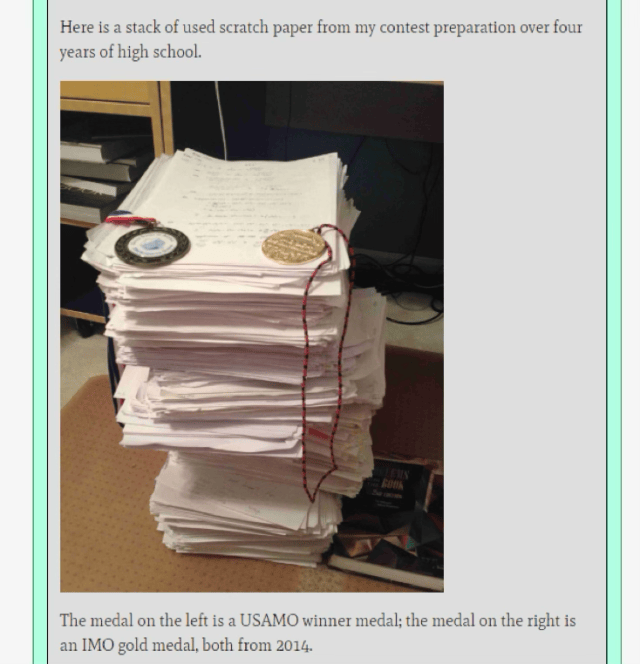
Here is the photo accompanying MPSS’s exhortation for “practice, practice, practice”.
*) (24/11/24) Following Anthony’s comment, I semi-stealth edited to make clear that a “problem” should be more than a straight-forward exercise.
**) (24/11/24) Another semi-stealth edit.
Australian Mathematics Trust has resources for teaching problem solving.
Yes. Utterly beside the point.
Perhaps there should be two questions. One is how do you teach someone who is interested? Here there is no shortage of books – Ian Stewart and Martin Gardner, the aops guys and many others that these people buy and work through often without a teacher. I am sure a teacher can help but most of the work is paced practice.
Then there is how can you teach people who are not interested. At the extreme this is akin to taking someone with no musical skill or aptitude and starting on the flute or violin.
If you take the factorization example it seems obvious to me that you could get to the problem solving stage only after familiarity with all the options is established.
I’d like to think you could get almost all students be good at this.
But as with the flute you have to ask is this a good use of everyone’s time? Because if you want people to be good math problem solvers you have to do this in every area of mathematics. People who are great problem solvers with factorization are still going to need to spend a lot of time on geometry, algebra etc. There is no end to this.
For some spending time on other areas, even the violin, might be a better choice.
Stan
PS My mother taught violin in our home during my childhood. While some of her students went on to perform professionally , it is not just cost that stops people trying to teach everyone some things.
I’m not interested in how you throw a book at an interested kid.
Interestingly, this is one of the things we spend most of our time thinking about. I have many ideas, but not on a Saturday night.
Thanks, Greg. I’m sure you have plenty of Saturday night ideas, but I imagine they more likely involve kids or wine or whatnot.
For whenever it’s not Saturday night, is the “we” Clarendon, or is the “we” the brain gang?
‘We’ is Clarendon
Thanks. Will be interested to hear.
Ahhh, the Holly Grail of creativity and problem-solving. Sometime between 1945 and 1953 with a break for a compulsory, for anyone who dares to creatively solve problems GULAG the Soviet engineer Genrich Althusller developed what he called the ‘theory of inventive problem solving’, the English acronym for it is TRIZ. Anyone interested can find quite a few web pages dedicated to TRIZ.
Somewhere closer to our shores and with less drama, although still with Soviet roots an American Mathematician Paul Zeitz had written a good book called ‘Art and Craft of Problem Solving’, which blends interesting problems with strategies, tools, and techniques to develop mathematical skills and intuition necessary for problem-solving.
Plenty of people have written books about problem-solving. I have not found any of the ones I’ve read, or attempted to read, particularly enlightening.
I am curious to know what teachers think, and with specific problems /topics in mind. In practice, how does this stuff work, with real live students?
I think you can’t teach “problem solving” any more than you can teach creativity. What you can do, is make sure that students have a good knowledge base to start from. So lots of explicit teaching in the regular classroom and some degree of practice for consolidation.
Very boring, very unsexy, so “educationalists” are never going to research or write about it. Hence the dearth of useful books.
What do art teachers do? Just teach technique and the creativity either is or is not there?
Solange, would you like me to delete this comment, as a repeat?
Yes. Please. Leave the edited one with the photo. I made a mistake somewhere. Thanks
I thought everyone who loves problem solving (in the original meaning) loves Polya’s books on problem solving. It’s actually all about asking the right questions (and knowing your basic techniques, of course).
Arthur Engel’s book on problem solving comes close; we agree on the rest.
I never found Polya’s books much help.
Imagine TRIZ or any other generic problem solving approach really was that useful. It should beat out say linear algebra as essential learning for all STEM students. Yet TRIZ is mostly unknown.
I think this is because most of these general ideas have almost no information content.
Taking the factorization example again most general problem solving ideas cover items such as don’t forget to try all the possible approaches. Reminding people to do this doesn’t take much compared to the time taken to master any individual approach.
On Greg’s blog someone provided helpful links to general problem solving strategies which included such insights as sleep on it. Again this idea isn’t something that takes a huge effort to explain or learn.
What takes time is knowing the possibilities well enough that your subconscious can pick the best approach without effort. That is what a good problem solver looks like.
I think that the use of appropriate mathematical representations in the “explanation” phase of explicit teaching (Rosenshine and Stevens, 1986) and in textbooks such as in the Singapore collection:
“Singapore math teaches students mathematical concepts in a three-step learning process: concrete, pictorial, and abstract. This learning process was based on the work of an American psychologist, Jerome Bruner.”
https://en.wikipedia.org/wiki/Singapore_math#:~:text=Singapore%20math%20teaches%20students%20mathematical,an%20American%20psychologist%2C%20Jerome%20Bruner.
P.S. Bruner was neither an educationist, nor a mathematician!
By the way, a very long time ago, medical schools used (and still use) appropriate representations in classrooms. Two months ago I saw some (beautiful and old) terracota medical representations in an Italian Science Museum!
Giuseppe Ferrini:
https://catalogue.museogalileo.it/multimedia/WaxTerracottaAnatomicalModels.html
Thanks for defining, seriously.
I wish I had the time to write a proper response, but alas, I am trying to set an exam – so this will have to do.
Perhaps one other definitional aspect that might help, or not.
It is only a problem if you do not have an immediate/already learned way to reach the answer.
Given this extra aspect, at least in my tiny mind, solving a problem requires only one thing, for the solver to “have an idea” (or two), that they have not had before.
If you accept this, then you also need to accept that this can not be “taught” to you by another person.
You need to learn to do it within yourself. The good news is that other people can help you to learn to do it within yourself.
If we are regularly immersed in situations where “having an idea” is required, we can become better at having ideas. Ground breaking; right?
Some ideas are easier to have than others.
The ease of having an idea seems to be related to how easily one’s mind, prompted by the stimulus (problem), can identify possibly useful facts/concepts and procedures and decide if they are of use or not. It is a kind of “will that help, oh no, what about …, of yes”. It always feels to me like a journey of test/reject, test/reject, test/accept, yay! ***
The mind can only identify potentially helpful fact/concepts and procedures if it a) knows potentially helpful facts/concepts and procedures and b) knows how various facts/concepts and procedures are connected to each other and knows how they are connected to various contexts. In my tiny mind this is best thought about by thinking that a “unit” learned lives in one of a zillion pigeon holes in our mind and that there are a myriad of connections between (and within) the pigeon holes, the more pigeon holes and the more connections the better chance that …
While “having an idea” can not be “taught”, we can learn to do it and be helped to learn how to do it. But how?
First kids need to know all of the above marlaky (in a kid form) and then be immersed in problems and allowed the time to having ideas.
Start with simpler problems, ones for which the fact/concepts and procedures needed are in easy reach, for which they already highly competent with and that are strong connected in their minds. Time lag. Early on problems should only require students to be recalling stuff they learned some years prior to now, so their chance of having an idea is high.
Then as they age/gain in both the desire to have ideas and confidence they can have an idea, steadily move on to harder problems, where the fact/concepts and procedures needed are not so obvious to the solver (less used, or less connected to the problem’s stimulus or …), up the ante.
Draw a unit square. Randomly place two points inside the square, or on its boundary. Measure the length of the line segment. Repeat, over and over and over … .
What would the average length be?
Turns out to be a little over a half, which is a lot less than half of root(2).
Why would that be?
I witnessed a Year 9 student have an idea about the square problem, on Friday, that was astonishing, an idea he had never been taught, nor had before. He has, though, been in a program for 5 years that has applied the above philosophy. He and his friends are fearless havers of ideas.
So, I do not think it can be “taught” to you by another person, but you can learn to do it within yourself, and other people can help you to learn to do it.
Mmm, maybe that is how you teach it?
But what would I know, I am just a teacher! 😂
***The best problem solvers I have worked with seem not to realise they are doing this (especially kids), they are simply so fast at the process, it is like they just have the right idea(s) off the bat. It took me a long time to come to this realisation. I valued my own (slow) thinking ability more after I realised this fact.
Thanks, Anthony. As I indicated below, it feels to me that one can do more. I’ve edited my definition of a problem to reflect your “no ready solution” clarification.
Something missing in my post above is the discussion that takes place about the ideas had, and the modelling (but me or other students), ie. explaining how an idea formed (if it can be articulated), “I thought …, because I noted …”. This is no small aspect of the process as I think about.
I will be keen to hear more.
Of course teaching more mathematics better, is one aspect of more.
Thanks, Anthony. I think that is a huge addition, and is getting to what I’m thinking of.
That’s where I think the specific problems matter for the nature of the probing and articulation. Then it’s a question of do the specific problems-probing-articulations provide any general guidance, for the students or the teachers.
If you, or anyone, wanted to see examples of “specific problems-probing-articulations provide any general guidance, for the students or the teachers”, you could find a substantial attempt at doing this at https://www.mathscraft.org
The attempt housed in that site has now evolved to an in school and in class time teacher training program.
I think Mathscraft is a great thing, but I’m not convinced it’s a good model-example of what I’m trying to get at here.
Indeed, quite possibly too “open”.
However, it is possible the way that pathways through the problems have been “written” up could be of help.
Most of my time in this space now is a more closed, single path, …, version of MC.
Yes, I think MC is too open.
I don’t think “single path” is what is wanted, or at least what is relevant here. But I think *shorter* path is important. Again, my interest is in the role of problem solving in classroom teaching. This is including, hopefully the plebs, not just the high flyer or medium flyer extension kids.
The first thing after one-step problems are two-step problems.
I think I referred to *shorter* path in my first dump.
We are currently working on the inclusion of “non-routine problem solving” as part of the regular program for every classroom at the school I am at. Next year we have 0.4 + teacher allocation to further develop the types of things we have done over the last two years. I will try to explain what that looks like, in actuality, a little more later on.
Please think:
There are three types of simple word problems for subtraction, and also three types for division.
How can students learn how to solve simple subtraction and division problems, if we (teachers) cannot even explain well (and explicitly, and with appropriate representations, etc.) the actions related to each of these six types of problems?
If students do not know which operation to use in a simple word problem involving a single operation, how are they going to be able to solve problems which involve multiple operations?
We are lost!
Perhaps the “critical mathematics educators” are right, and we should be teaching history instead:
This is starting to annoy me.
First, no videos, unless there is a really compelling reason. I really cannot stand argument by video.
I’m also not particularly interested in wails of how lost we are. One hardly needs to preach such things at this blog.
I’m also not interested in grand theories of problem-solving, or in being reminded that there are good popular maths books, and so forth.
I am definitely not interested in elitist, flippant waves of “some kids have it, some kids don’t”. I think it is obvious that practice on good and appropriately chosen problems is a benefit to all kids. It doesn’t have to be, and obviously shouldn’t be, Olympiad stuff.
The reason mathematics education theorising is so often so useless is because it is so often couched in meaningless generalities. There may be worthwhile generalities to declare, although probably fewer than people wish, but first must come the specifics. The devils, and the angels, are in the details.
I asked the question of this post out of genuine interest: how does problem-solving, specifically good and meaningful problem-solving, fit into classroom teaching? I also posted a few specific problems, about which no one has yet made a single comment. Maybe they’re not great examples for the dicussion, but there have been essentially no specifics discussed at all. For me, this non-specificking has to be the wrong approach.
Maybe the specifics will not tell us much. Maybe, as Anthony suggests, having an idea cannot be taught, and the best teachers/schools can do is present carefully chosen and very good problems, and then provide the kids the space and the time and the encouragement to have ideas. I’m not convinced but Anthony knows this game much better than most, and much much better than me, so maybe. But bald declarations won’t convince me.
The comments so far are helping to clarify my own thoughts, and so thank you. But there is little above with which I agree.
I thought this “Bad Mathematics” was a sort of a discussion group. In a real discussion, I do not think we should be only pleasing others, especially when things are not going well in many countries. I do not care if others agree or not with me. If others are annoyed or not by what I think. I just know for sure that some asian countries are somehow doing much better than many countries. That is the reality. Not only the reality shown by the stupid problems in PISA exams. Famous universities in England are full of asian doctoral students doing research in pure mathematics (not about maths education) and in maths related research areas. So, my suggestion is: simply find out what some countries (such as Singapore) are doing right. It may also help to know what crazy ideas are being preached in very bad achieving countries like mine by Boaler and others.
Please stop being annoyed by the suggestions of maths teachers like me. I was just trying to help. Not helping you, but helping in the teaching of school students.
Solange, it’s not about pleasing me: it’s about addressing the question (and not posting videos).
Maybe I was a little too grumpy. No question that I’ve had people on and about this blog pissing me off lately, and perhaps some of that was transferred. Also, this is a blog and there is no particular price signal for posting a comment, and one cannot expect to impose one. (Other than when people *really* piss me off, and I start editing or deleting.) But I really didn’t think much of the comments. Any of them.
At the risk of incurring wrath, I think that the approach to this is integration. I agree with explicit teaching approach, but these sorts of things could be integrated at the end of more straightforward, and related, exercises where prior knowledge has been explicitly taught and is being practiced. I think that they are a form of ongoing stretch exercises, along with “wordy problems”. Doing this sort of thing regularly builds up a familiarity with solving these sorts of problems and a bank of techniques to draw upon. I guess this is being taught by example when you go through the solutions in class. So, this is still somewhat explicit, but maybe explicit on the part of a student who has solved it well.
Thanks, Neil. I seem to have more than my normal (high) level of wrath these days.
I agree, for at least some level/sense of problem-solving, that such problems reasonably amount to the harder “exercises” and “explorations” or whatever near the end of a topic. As I wrote in the post and as commenters have noted, a kid can’t possibly tackle the deeper problems if they can’t do, solidly, the individual steps that might be required. But, I think that still leaves some issues and some unanswered questions.
First, what is the source of such deeper problems? The textbooks? I see very little if anything in the texts of good problems in the sense that I am advocating. Where else?
Secondly, good problems need not be “wordy” and usually are better if they are not. Gardiner’s problems above are not wordy (accepting that kids consider more than two words in a problem sufficient to declare it wordy). The AMC problems are lovely for their lightness on words.
Thirdly, this is still ducking the question of *how* one teaches problem-solving. Do you simply present the (hopefully good) problems to the kid and then it’s “Good bye and good luck”? This seems to me generally what is done with the harder “problems” at the end of a topic: they’ll be assigned, or pseudo-assigned, and some (i.e. two) kids will attempt a few, but there is seldom any teaching of these problems or follow-up, or anything. I honestly don’t see much genuine integration here.
Fourthly, is that all there is? This is not to trivialise what you are suggesting. If it were done well, with good end-of-topic problems selected, and with some genuine engagement – the kids with the problems, and the teachers with the kids with the problems – that would be significant. But I feel there should be more, if only by getting into the extension world.
In relation to your four points above:
Unfortunately I am not familiar with any (especially recent) texts that could supply good examples of these problems.
My comment about “wordy” problems was meant to imply a second category, not that in order to be a good problem they needed to be wordy. It is really another class of problem that should be included.
Yes, I have not expanded on the how. I think that example and practice are important. It is a bit like the difference between an answer and a solution. the more straightforward (i.e. simple or one step questions) may be simply a case of an answer and follow up any misconceptions. The problem solving needs to be gone through in more detail in class. I would suggest that teaching how to approach these is done by example. Maybe initially with problems solved in class, then those to be done by the students and gone through in class as a follow up. Sorry but that is the best I can see at this time. There will be issues with time constraints and allowing sufficient follow up time. I liken this to any problem-solving exercise, it takes time to think on (or sleep on as someone else said), experience to draw on and the three P’s: practice, practice, practice.
Is that all there is? Well from me yes. Others may have other ideas. Maybe getting the students interested in non-curricula puzzles would be a help? A recent Doctor Who chided “Don’t you people do recreational maths?” Maybe there is something in that. Someone in this stream mentioned Sudoku but this is a logic puzzle and only requires you to count to 9. It does involve some strategy but does not fall anywhere near the multi-step problem solving exercises.
Thanks, Neil. I don’t think there are easy answers, although undoubtedly PPP is a key ingredient.
Maybe we can get some ideas on learning about problem solving from the world of chess problems.
In his famous work, A Mathematician’s Apology, G. H. Hardy compares and contrasts chess problems with mathematical problems.
According to Hardy, “a chess problem is simply an exercise in pure mathematics”. But he goes on to say: “A chess problem is genuine mathematics, but it is in some way ‘trivial’ mathematics.” By this he means that chess problems do not involve higher mathematics. He then adds a delightful remark: “if a chess problem is, in the crude sense, ‘useless’, then that is equally true of most of the best mathematics” (p. 16).
The late Richard Guy composed some famous chess problems. Raymond Smullyan was a mathematical logician who wrote an entertaining book– perhaps the most entertaining book – on chess problems. After completing a DPhil from Oxford in pure mathematics, John Nunn (b. 1955) has gone on to become one of the world’s leading chess problemists.
Of course, I could probably find five mathematicians who were interested in golf but that would not make golf a mathematical activity. But I hope that you get the drift of my point. Solving mathematical problems and solving chess are allied activities. Indeed, Rouse Ball and Coxeter devote a chapter to chess board problems.
Rather than getting ideas on learning about problem solving from the world of chess problems, why don’t we get ideas on solving *mathematical* problems from the world of mathematical problems?
Simplify.
I was trying to point out that chess problems are mathematical problems. Sudoku puzzles are also mathematical problems. I have found that students at all levels enjoy Sudoku puzzles.
I’ve found that students at all levels enjoy ice cream.
Why can’t the answer be as simple as you have to spend time on the problem solving part. In the case of factoring it is spending time where the student has to choose the best method.
You see this approach in John Mighton’s explanation of the approach he developed for Jumpmath. In the case of times tables or any arithmetic there are several options that depend on the context. You can train each one but then spend time where the work is choosing which one is best is most of the work.
You could say all his work is addressing the problem you are asking- how to get all students to enjoy mathematical problem solving.
Mighton has not been shy about explaining his approach and the jumpmath org has done some work to curate research on the topic and their success.
It is definitely aimed at all students and not elitist.
I have heard of jumpmath, of course, and have heard good things. The one time I looked briefly, I don’t think I was that thrilled, but then you have to compare it to the alternatives.
I’m not really focussed on students enjoying problem solving, although that is obviously a big part of it, and everything. Which is why choosing problems very carefully is so important.
But I don’t think the answer can be as simple as “spend time”. Of course time and practice are key to learning anything but, again, problem solving is not an X. I don’t think standard commandments for teaching X can apply to teaching problem solving without harder thought.
I’ve clearly come late to this discussion – all very interesting, all somewhat concerning as well.
Perhaps there is no “way” to teach problem solving. Instead, perhaps the strategy should/could be to teach/demonstrate a variety of ways of solving problems and then set a series of assessments.
Somehow the threat of a grade motivates a lot of students to try…
From the discussion above though, I do have to question the assumption that problem solving can, indeed actually be taught. Hopefully it can.
How I would approach question (A) with a class with varying abilities:
1. I would first let students have a go. See what their thoughts are.
2. I would have some prompts to encourage certain thoughts for those who are struggling.
e.g. Can you draw a factor tree for 30? Is there a way to make 5×6 into three numbers multiplying?
3. Once enough students have finished, there would be a discussion of approaches that the class did. Also, I would have samples of different approaches for students to look at. These would be good and bad approaches. We would discuss why certain approaches were more fruitful or efficient than others. I would also talk about my prompts. Why did I ask them? I would also ask if any of the methods are applicable to other problems we have done. I would also have some examples of that prepared.
My approach is to give students experience. From someone (the teacher) who has more experience.
As pointed out before, the questions should illuminate certain things important to learn about a concept or how multiple concepts link together.
Reflecting back, it has been the experience of others that have helped me further develop my ability to problem solve.
This is me trying to emulate that. I think it will have varying outcomes depending on abilities and dispositions of students.
Thanks, Potii, and sorry. I just noticed your comment was caught in spam.
The best time I was helping students with problem solving skills wan in 2020 Covid year with a year 7 class. We had online teaching and my school using a “stupid Maths learning platform” (thank God it’s gone now) for usual learning and there is no way I could assess if they had learnt anything. To engage students, I gave them weekly challenges: all sort of problems that I collected over the years Nrich, Maths 300, the chalkface… (my university’s Maths’ mentor is crazy about problem solving and gave us so many resources). Surprisingly, students all loved those problems. They often took pictured of their working out and submitted via Google classroom and sometimes their way was so much better than my solution. Some of them can articulate their reasoning perfectly to my utter delight. Basically we did that for the whole year. Now we back to explicit teaching and the usual unit/subject timeline, the curriculum and achievement standards. It’s so dense and overly ambitious about what a year 7, 8 … can do that I could not find enough time for regular problem solving tasks for the whole class to work on . So it becomes more of an extension. While I helped out some below – level students, the above level kids worked themselves through challenges without my help. But it could never goes back the the peak of 2020.
Thanks, Victoria.
The pandemic was a weird and stressful time, and congratulations for finding a way to have you and your kids work through it. I’m not surprised that the students loved the problems. I would have to see them before deciding if I agree.
The last thing I’d call the Year 7-8 curriculum is overly ambitious, although it’s overly something. A blivit, as Vonnegut referred to such things.
1. Nothing new here, but fluency and accuracy go a long way. A big part of “mathematical problem” solving comes to recognizing a pattern (i.e. where a particular transformation can be applied, often algebraic), then mentally playing out what happens when that is applied, the process is then repeated.
Recent personal experience from teaching my daughter – She used to freeze when looking at the harder multistep problems. Situation improved a lot after I got her to do some practice on more tedious algebra manipulation from some old Mir published textbooks, she became happier to write down some equations and think about it instead of stopping if she can’t see the solution right away. Specific issues that get addressed include:
– not enough practice in general
– not enough exposure to the same idea in different forms. Could be something mundane like recognizing a quadratic of expressions other than a plain “x”.
– mental stamina.
2. Those counting questions need to be taught with some more theory, can’t just be an ad-hoc random have fun question. It needs to come with at least a cut down version of the counting techniques that’s usually in the year 10/11/12 curriculum.
3. Highlight exceptions and situations where techniques don’t work. I find this makes learners actually think about what they are doing. Another way to do this is to present an incorrect solution with a not so obvious mistake and ask the learner to find the error.
4. Developing heuristics – Could be “obvious” things like thinking about factors and prime factors when products of whole numbers are involved or think about gcd / lcms when there are different frequency cycles. Could be less obvious things like looking for recursions when counting. I don’t know of a way to teach this other than a lot of practice.
I think all of this only works in small groups and probably not in an average classroom in Australia given where the bar is set in terms of progress and difficulty, how much time pupils spend on maths and the overall expectation a school / parent have.
“How, generally, does one teach the techniques, or perhaps the art, of problem-solving?”
This is exactly what I do. There is no substitute for gaining as much experience as possible. This means studying old test papers, and especially the problems that you could not solve.
I like to share this image originally posted by on the AoPS message board. It shows a tall stack of scratch paper, topped off with USAMO and IMO medals. There is no royal road indeed.
https://www.dropbox.com/scl/fi/9iepxteugd0pektwy7rga/stack-of-scratch-paper.pptx?rlkey=nrea2lsxshjll9ga2ebz3nz0h&st=tpccj1kc&dl=0
Here are some specific techniques I use.
1. I actually solve a problem while the student watches me. I say out loud what I am thinking so he can follow my thought process. I will say something like, “This bisected angle makes me think of the angle bisector theorem, so let’s try that.” Sometimes, for example, the ABT isn’t what leads to a solution after all, so I make sure to point that out to the student explicitly. “Wow, turns out we didn’t need ABT after all!”
2. I ask students to keep a notebook of hard problems. They are to write out the problem statement, and then a full solution. Let a week elapse, and then try to solve the problem again. Let a month elapse and try it again.
3. Fill in any gaps of knowledge. Most students will have studied algebra and geometry, so a quick back-of-the-envelope proof/reminder is all that’s needed. But US schools typically neglect counting and probability, so for my students who have a big C&P gap, I will recommend they study that material systematically. It isn’t hard to grok, but it really helps to have a systematic introduction.
4. I model good problem-solving writing. Equals signs are lined up. Diagrams are drawn and then re-drawn when they get too bogged down with details it’s difficult to see what is going on.
5. Always re-read the problem before reporting your answer. Answer the question that was asked.
But mostly it’s practice practice practice. Hope this helps.
stack of scratch paper
Thanks very much, MPSS. It’s a great photo.
(I can post the photo as an image if you wish, but don’t want to do so without your permission.)
You don’t indicate the context/audience for your problem-solving, but it sounds more like mathematics competition stuff rather than lower level classroom stuff, which was more the intended focus of my post. (I suspect even extension-type classes are significantly lower in difficulty/expectation than what you are discussing.)
What you write is very interesting and rings true, at least but not only for your world, particularly the last line, plus photo. I still wonder how this plays out with specific mathematics, and then how/if that transfers to other specific mathematics.
Also, the way you describe it, it would seem your teaching is very lecturey (point 1). For less strong kids, this would not work, and even for your kids perhaps it is less like this than your point 1 suggests?
Sure, you can post the image directly. (I forgot to complete the form; this is MPSS again.)
Yes, this is math contest stuff, but this was also how I learned in high school. We studied a regular math curriculum, then monthly we took a math contest, written by our teacher, for a small amount of extra credit. It was basically AoPS before there was AoPS. (See photo sample attached.)
Our lowly public high school punched above its weight in math contest performance, to where we were scoring as well as some of the more famous high schools in the US. I learned by watching my teacher solve problems at the board. Every month I tried a contest. Eventually I figured it out.
I’m not sure what you mean by “specific mathematics.” Contest problems are all math. You just never know what is going to appear in the next problem. Most of it should be material you’ve seen before; some of it will be new.
You can find math contests at all levels of difficulty: Math Kangaroo is appropriate for 6 year old students. Find the contest level where you can solve roughly 1/3 of the problems and go from there. For less strong kids, use lower level contests, teach them what they don’t know and then level up aggressively.
Please always type a name when you comment. I *really* cannot stand multi-Anonymouses.
Anyway, thanks again, and I’ve updated the post with your stack photo.
We’re still talking a bit at cross purposes. I strongly agree that problem solving competitions are very generally valuable, and it *really* pisses me off that in Australia this is all dominated by Polo Grammar and its kin. See this post.
What I am more pondering in this post, however, is the role of, and the teaching of, problem solving directly in a classroom setting as part of the regular curriculum. This is then the teaching of simpler problems on quite specific mathematics to (at least some) significantly weaker and less motivated students. My question is how to teach to such a class. Then, my second question is the extent to which the answer to the first question is topic-specific.