
I had been planning this post for a while, but Burkard prompted the post to be moved up the list and prompted some addition to it.
Earlier this year, the result of a friend’s suggestion, I made a rather long drive for a rather short engagement. It was supposed to be two engagements but one person reneged. Such is life; the word of some people is worth more than others’. Anyway, two engagements or one, it was a lot of work for a busy and tired Marty. Was it worth it? It depends upon how one calculates such things, which is the subject of this post.
Last week, I traipsed out to Monash University, to watch Burkard give a Lunchmaths talk. It was lovely to witness. Lunchmaths was a seminar series for undergraduates that I began twenty-five years ago, when Monash Mathematics was at the height of its depths and there were no regular seminars for anyone, undergrads or overgrads. Then, we had talks from anyone I could cajole or kidnap, and from me and Burkard, of course, and also memorably and repeatedly from John Stillwell and Mike Deakin and Hans Lausch. It was heartwarming to witness Lunchmaths still going and going strong, currently in the safe hands of Norm Do and his obedient slaves willing and able students.
Burkard gave a beautiful talk – quelle surprise – on new insights into John Conway’s knot dance, and afterwards Burkard and I went for our traditional hot chocolate/coffee debrief. We talked about this and that, and the conversation drifted to the beginnings of our collaboration, twenty-five years ago, when we began giving our public MAV talks at the Melbourne Museum. And then Burkard had a thought:
“We really should give some museum talks again.”
I responded in the appropriate manner, gently suggesting that Burkard had lost his mind. Had he forgotten how much work the things were, and how much work it was to get people to turn up, to volunteer their free leisure time to listen to a talk on mathematics? Burkard hadn’t forgotten entirely. It’s just that he regarded our newspaper column as the real killer, that the museum talks weren’t that much in comparison, and so, why not?
It was this kind of Carrollian logic that resulted in us doing anything and everything in the first place. By the end, when we wound it up in 2015, we were absolutely buggered. But it seems that ten years is sufficient time for Burkard to have forgotten enough to ponder doing some of it again. Not me.
Whether or not there is any sense in doing it again (not), Burkard and I agree that it was a great-crazy journey to have taken. To have been flat out mathematical troubadours for that long was a unique and hugely rewarding endeavour. It was one experience along the trek, together with my recent drive, that resulted in the ponderings for this post.
All of our doings were organised by the brilliant MAV CEO, Simon Pryor, who always seemed bemused to have been handed two nutty mathematicians willing to volunteer for anything, but who also clearly valued it and was always dreaming up new schemes. One such Simon scheme was to “take the show on the road”, to bring our public talks to rural Victoria. This was ambitious.
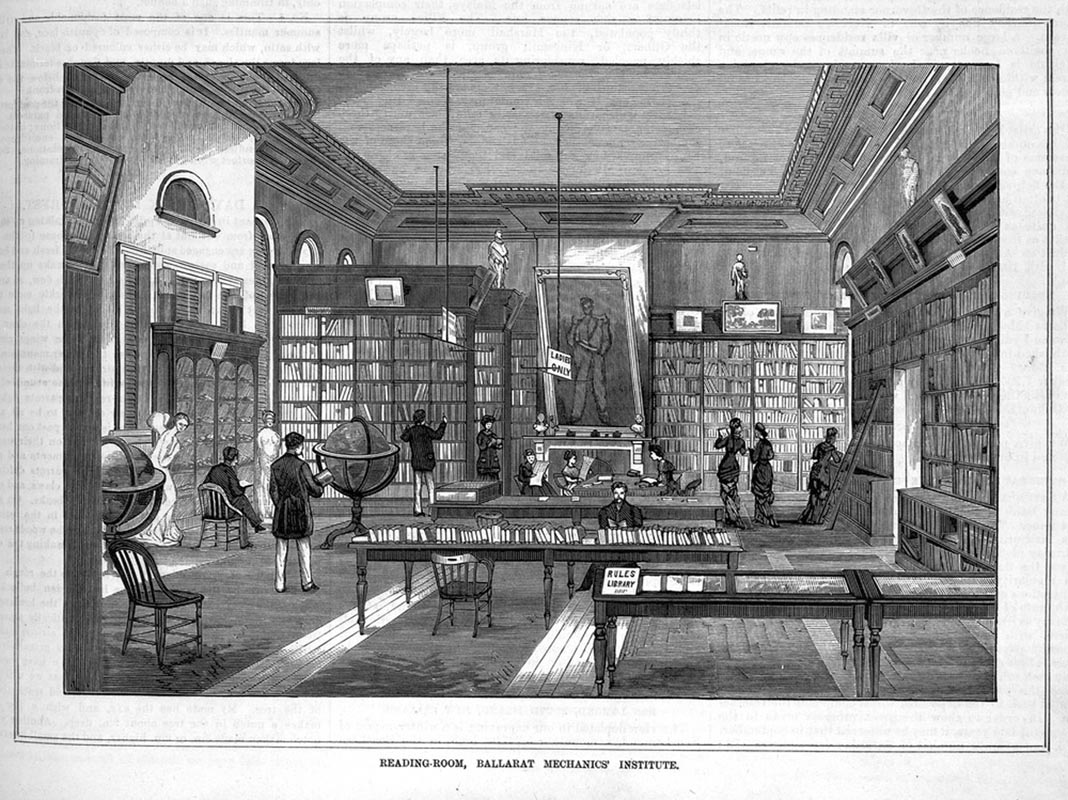
It is difficult enough to gather an audience for a mathematics talk in cosmopolitan Melbourne, and to do so in the boonies is a very tough ask. With Simon’s inexhaustible P. T. Barnuming, however, we ended up having some moderately successful and very enjoyable trips. Notable were trips to the goldfields, giving talks in Bendigo and Castlemaine and Ballarat. A particular buzz was to give a talk at Ballarat’s Mechanics Institute, in the same beautiful Reading Room in which Mark Twain had talked a century earlier. One trip, to Hamilton and thereabouts, was much less successful; that trip, which was painful teeth-pulling throughout, included me giving a talk in a very large theatre to three men and a dog, give or take two men and a dog. Very memorable in its own bleak way.
The other trip was to Mildura, in the northwest corner of Victoria. It was a pretty good trip, of mostly school talks, but it also included a pretty strange detour, to Rainbow: that’s the purple dot on the map above. Rainbow is the Nowhere once you’ve made it to Nowhere.
That weird detour occurred the way most of these things occurred: someone asked and we didn’t think to say no. Stephen, an organisationy teacher in Rainbow, contacted me and Burkard through QEDcat.com, asking if we could give some talks at his school. It then seemed easiest, and free for the school, to piggy back these talks onto the Mildura trip, since Rainbow would be just a short 240km out of our way. And so, one dawn, I drove off into the woollen wilderness of Victoria’s west, gave a trio of talks, chatted to teachers over lunch and drove the hours back to Burkard and Simon, who had kept things ticking along in Mildura.
I don’t recall that the Rainbow talks went that well. Back then, I was not so clear or confident talking to kids, and these were not exactly the easiest kids: when the teacher flags that “I am out all day tuesday at the shearing school with the year 9s”, you know you’ve entered a very different world. Still, there were some positive vibes, it was very good to meet and talk to Stephen and the other teachers, and they were very grateful.
While chatting last week, I reminded Burkard of Rainbow and the eccentricity of the trip. Not that I ever doubted it was worth doing but how do you explain why? Burkard summed it up pretty well:
“Well what would you have done otherwise?”
Which gets to the truth. Yes, I would have been doing something, but I wouldn’t have gone to Rainbow. I wouldn’t have seen, at least very briefly, that world and I wouldn’t have met the students and the teachers of that world. Maybe my visit made a little difference to some student or some teacher, and very possibly not; it can be very difficult to tell beforehand, and even afterwards. But going to Rainbow, having done it and having given it a go, was the value and the reward.
That seems the right and necessary attitude to such things, to try as hard as possible to not be transactional about them. If someone is requesting your time or your contribution then it is better to trust them, that their act of asking is evidence enough that there is likely value; that it is worth the gamble; and that the worst that can happen is that you find out otherwise, that you learn something about people and the world that you would have not have learned otherwise. Burkard and I met many great people and had many great experiences that we could not possibly have planned or imagined, by always being willing to roll the dice.
My drive earlier this year was worth it in that manner. I do not know that I learned much new, anything really worth a day’s work. But I learned that there was perhaps not so much to learn, and I learned about the person I met (and about the person who reneged). I liked them a lot and I admire them a lot, and although I am not sure there will be much future connection, one never knows. It was much better to have met than have not.
Sensible life and the finiteness of time necessitate decision and choice, but sense is overvalued, is not nearly as sensible as people imagine. Meeting new people of whom one knows little and trying things of unclear worth are typically worthwhile simply by being unknown, and are typically worth a decent effort. The dice are your friends.
I gave a public lecture a few weeks ago; took a lot of work, but it was worth it; 180 registered but I reckon that about 160 attended; probably my last hurrah.
GsWatsonFlyer
Wonderful! Why didn’t you tell us?
Was it recorded?
Sorry to have missed it Terry – sounds very interesting
You’ve contributed a new and very nice phrase to the Eng Lang …. ‘going to Rainbow’.
Indeed. Not consciously but, yes, it has a lovely ring.